News

How Does Foam Thickness Affect the Adhesion Performance of Puffy Stickers?

2026-11-16 0 Leave me a message

A puffy sticker is a small product with a large sensory appeal. It is soft to the touch, dimensional, and often used on packaging, stationery, toys, and promotional items. The puffiness comes from a foam layer that sits between the printed surface and the adhesive. That foam layer is what makes the sticker distinctive, but it is also what makes the adhesion behavior complicated. A thin foam layer behaves like a conventional film sticker. A thick foam layer behaves like a compressible cushion that can absorb peel forces, distribute shear loads, and change the way the adhesive wets the surface. For a procurement team sourcing Puffy Stickers, the foam thickness is not a cosmetic detail. It is a design variable that determines whether the sticker stays on the surface, how it fails when it is removed, and which surfaces it can be applied to.


This guide is written for buyers who need to specify Puffy Stickers for retail, packaging, or promotional applications. It explains how foam thickness interacts with the adhesive, how the peel and shear behavior changes across the thin, medium, and thick ranges, how the adhesive type and the surface energy of the substrate affect the result, how testing can reveal the performance, and how procurement can verify the foam thickness and the adhesion claims before placing an order. The content is organized around the questions a buyer should ask, and it includes the product parameters and test documentation that a reliable supplier should provide. Our factory at Wenzhou Create Fun Craft Co., Ltd. produces Puffy Stickers across the foam thickness range, and the guidance below reflects the engineering and procurement questions we address with our customers.

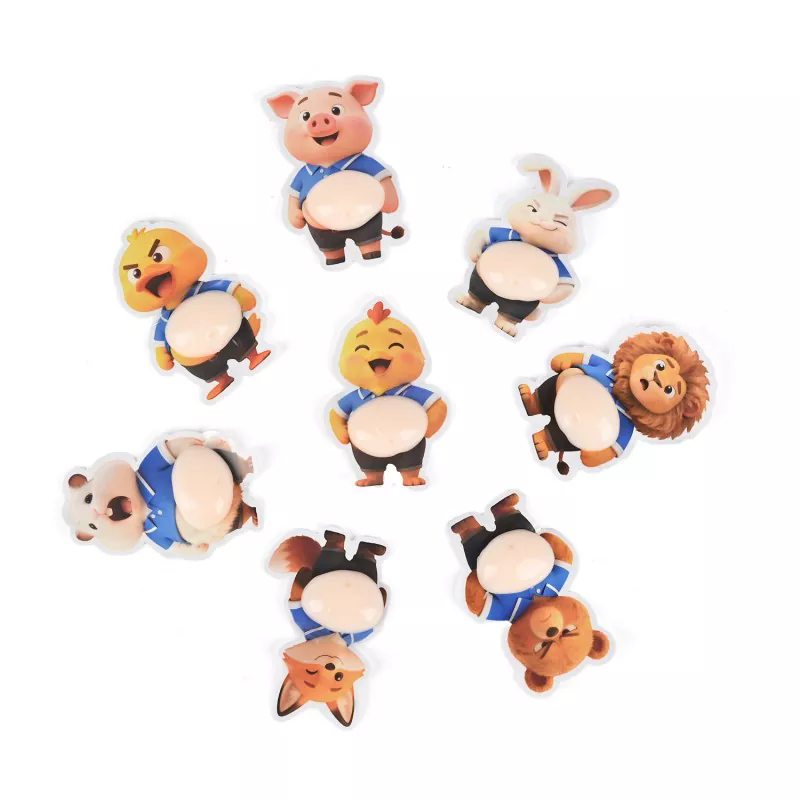
Squishy Peach Butt Puffy Sticker


Table of Contents


1. What Role Does Foam Thickness Play in the Adhesion Mechanism of Puffy Stickers?

The adhesion of a Puffy Sticker is a competition between the adhesive bond and the stresses that try to separate the sticker from the surface. The foam thickness influences both sides of that competition. On the adhesive side, the foam acts as a carrier. A thin foam carrier is stiff and transfers the peel force directly to the adhesive line. A thick foam carrier is compliant and can deform, which changes the angle at which the peel force is applied to the adhesive. On the stress side, the foam acts as a cushion. A thick foam can absorb part of the peel energy by compressing and stretching, which reduces the instantaneous load on the adhesive. The result is that the same adhesive can behave differently depending on the foam thickness it is coated onto.

The mechanism can be described in three stages. In the first stage, the foam compresses under the application pressure, and the adhesive wets the surface. A thicker foam requires more pressure to achieve the same wet-out, because the foam absorbs part of the force. In the second stage, the foam stores elastic energy. When the peel force is applied, the foam releases that energy and can help the adhesive resist the peel. In the third stage, the foam can fail cohesively if the peel force exceeds its tear strength, leaving foam residue on the surface. The table below summarizes the role of foam thickness in these stages.

Stage Role of Foam Thickness Effect on Adhesion
Application and wet-out Thicker foam absorbs more pressure Requires higher application force for full contact
Peel initiation Thicker foam changes the peel angle Can reduce the peak peel force at the adhesive line
Peel propagation Thicker foam stores and releases elastic energy Can either assist or resist separation depending on the geometry
Cohesive failure Thicker foam has lower tear strength per unit area Can leave foam residue if the peel force is high

At our factory, we control the foam thickness and the foam density as a matched pair. A thick foam with a low density is very compliant but can tear easily. A thick foam with a high density is more cohesive but less conformable. We specify the pair for the application, and we test the peel and shear performance on the target substrate. The goal is to provide a Puffy Sticker whose foam thickness supports the adhesion rather than undermining it.

For a buyer, the practical lesson is that foam thickness cannot be evaluated in isolation. It must be evaluated with the adhesive type, the foam density, and the substrate. A thick foam that performs well on a smooth plastic surface may perform poorly on a textured paper surface. The procurement specification should state the substrate and the expected peel and shear values, not just the foam thickness.


2. Why Does Thicker Foam Create Different Peel and Shear Behavior?

Thicker foam creates different peel and shear behavior because the foam changes the geometry of the load path. In a peel test, the load is applied at an angle to the surface. A thin foam layer keeps the adhesive close to the surface and the peel angle steep. A thick foam layer lifts the adhesive away from the surface and changes the angle at which the load reaches the bond line. This geometric change can reduce the peel strength measured in a standard test, even though the sticker feels more compliant. In a shear test, the load is applied parallel to the surface. A thin foam layer transfers the load directly to the adhesive. A thick foam layer deforms in shear and distributes the load over a larger area, which can increase the shear strength but also introduce a time-dependent creep behavior.

The scenario below compares a thin foam Puffy Sticker and a thick foam Puffy Sticker on the same substrate.

  • Thin foam, peel: The peel force is concentrated at the bond line. The measured peel strength is high, but the sticker can feel stiff and may not conform to a curved surface.
  • Thick foam, peel: The peel force is distributed through the foam. The measured peel strength may be lower, but the sticker conforms to the surface and can absorb impact without lifting.
  • Thin foam, shear: The load is transferred directly to the adhesive. The shear strength is high, but there is little compliance if the substrate moves.
  • Thick foam, shear: The foam deforms and distributes the load. The initial shear strength may be lower, but the joint can accommodate movement and may resist creep better over time.

The table below compares the typical peel and shear behavior across the foam thickness range.

Foam Thickness Peel Behavior Shear Behavior Typical Application
Thin (0.5-1.0 mm) High peak peel, stiff High initial shear, low compliance Flat packaging, labels
Medium (1.0-2.0 mm) Balanced peel and conformity Good shear with some compliance General promotional stickers
Thick (2.0-4.0 mm) Lower peak peel, high conformity Distributed shear, creep possible Curved surfaces, toys, impact areas

At Create Fun, our factory produces Puffy Stickers in all three thickness ranges and tests the peel and shear behavior on representative substrates. We advise our customers on the thickness that matches the surface and the load. The goal is to avoid the common mistake of assuming that thicker foam always means stronger adhesion. Thicker foam changes the behavior, and the change must be matched to the application.

For a buyer, the peel and shear data should be requested for the specific foam thickness and substrate. A supplier that provides only a single peel value for the entire product range is a supplier that is not accounting for the thickness effect. The procurement team should ask for the test method, the substrate, and the foam density, because these variables determine whether the data is relevant to the application.


3. How Does Foam Thickness Interact with Adhesive Type and Surface Energy?

The interaction between foam thickness, adhesive type, and surface energy determines the final adhesion performance. There are three common adhesive types used on Puffy Stickers: acrylic, rubber, and hot-melt. Acrylic adhesives are durable and resist UV and aging. Rubber adhesives provide high initial tack but may degrade over time. Hot-melt adhesives provide high tack and are economical but may be sensitive to temperature. Each adhesive type interacts differently with the foam thickness and the substrate surface energy. The table below presents a compatibility matrix.

Adhesive Type Best Foam Thickness Surface Energy Preference Procurement Note
Acrylic Medium to thick Low to high Good for long-term outdoor use
Rubber Thin to medium Medium to high High initial tack, limited aging
Hot-melt Thin Medium Economical, temperature sensitive

Surface energy is the property of the substrate that determines whether the adhesive can wet it. A high surface energy substrate, such as glass or smooth plastic, accepts the adhesive easily. A low surface energy substrate, such as polyethylene or a powder-coated surface, resists wetting. A thick foam can help on a low surface energy substrate because it can conform to the surface and increase the contact area, but it cannot compensate for an adhesive that is not designed for low surface energy. The combination of a low surface energy substrate, a thin foam, and a rubber adhesive is a common cause of sticker failure in the field.

At our factory, we select the adhesive and the foam thickness together for the target substrate. We test the combination on the actual surface or on a surface with a known surface energy. The goal is to provide a Puffy Sticker that wets the surface and holds the load, not just a sticker with a high lab peel value on a glass plate.

For a buyer, the adhesive and foam combination should be specified together with the substrate. A supplier that asks for the substrate before recommending the foam thickness is a supplier that understands the interaction. A supplier that recommends the same combination for every substrate is a supplier that is likely to deliver a product that fails on the low surface energy surfaces.


4. What Testing Methods Reveal the Adhesion Performance Across Foam Thicknesses?

The testing methods that reveal the adhesion performance across foam thicknesses are the peel test, the shear test, the tack test, and the environmental aging test. Each test measures a different aspect of the bond, and each is affected differently by the foam thickness. The peel test measures the force required to remove the sticker at a defined angle. The shear test measures the time or the load required to slide the sticker under a parallel force. The tack test measures the initial wet-out and the quick stick. The environmental aging test measures the retention of adhesion after exposure to heat, humidity, and UV. The checklist below describes the test conditions that should be specified for each method.

  • Peel test: Specify the peel angle (90° or 180°), the peel speed, the substrate, and the dwell time. The foam thickness changes the peel angle at the bond line, so the test must state the thickness and the density.
  • Shear test: Specify the overlap area, the load, and the temperature. The thick foam deforms in shear, so the test should record both the initial shear strength and the creep behavior over time.
  • Tack test: Specify the probe or the loop method, the contact pressure, and the dwell time. The thick foam absorbs pressure, so the test should state the application force.
  • Aging test: Specify the temperature, humidity, and UV exposure. The thick foam may absorb moisture differently from the thin foam, so the aging test should include the foam thickness as a variable.

The table below summarizes the test methods and the parameters that should be reported for each foam thickness.

Test Method Key Parameter Thickness Effect Procurement Value
Peel test Peel strength (N/25mm) Thicker foam changes peel angle and peak force Confirms removal behavior
Shear test Shear strength (N) and creep (mm/h) Thicker foam distributes load and may creep Confirms load-bearing behavior
Tack test Loop tack (N) Thicker foam requires more application pressure Confirms initial adhesion
Aging test Retention (%) Thicker foam may absorb moisture Confirms long-term performance

At Wenzhou Create Fun Craft Co., Ltd., our factory performs these tests on representative samples of each Puffy Sticker design and provides the results with the product documentation. We also test the same foam thickness on different substrates to confirm that the performance is matched to the application. The goal is to provide evidence that the foam thickness and the adhesive are working together, not just that the sticker has a high lab value on one surface.


5. When Should Buyers Specify Thin, Medium, or Thick Foam for Their Application?

Buyers should specify the foam thickness based on the substrate, the load, the removal requirement, and the visual effect. The decision matrix below maps the application scenario to the recommended foam thickness.

Application Scenario Recommended Foam Thickness Reason Procurement Check
Flat packaging and labels Thin (0.5-1.0 mm) Stiff, high peel on flat surfaces Confirm peel and shear on the packaging material
Promotional stickers for general use Medium (1.0-2.0 mm) Balanced conformity and adhesion Confirm the substrate and the dwell time
Curved or textured surfaces Thick (2.0-4.0 mm) Conforms to the surface and absorbs impact Confirm the foam density and the cohesive strength
Toys and children's products Medium to thick Soft feel and secure adhesion Confirm safety and small-part requirements
Outdoor promotional use Medium with acrylic adhesive UV resistance and durable bond Confirm the aging test data

The visual effect also influences the choice. A thin foam produces a subtle puff. A thick foam produces a pronounced cushion. The buyer should match the thickness to the brand's expectation and to the product's handling. A thick foam sticker may be more prone to edge lifting if the adhesive is not matched to the foam compliance. A thin foam sticker may be more prone to curling if the substrate is flexible. The procurement team should test the visual and the functional performance together.

At our factory, we support the selection by providing samples across the thickness range and by testing the samples on the customer's substrate. The goal is to make the selection based on the actual performance, not on a catalogue image.


6. How Can Procurement Verify Foam Thickness and Adhesion Claims Before Ordering?

Procurement can verify the foam thickness and the adhesion claims by using a structured verification sequence that covers the sample, the measurement, the test data, and the production control. The checklist below provides the verification steps.

Verification Step What to Request or Measure Acceptance Criterion
Foam thickness measurement Micrometer measurement at multiple points Within the stated tolerance
Foam density Density specification from the supplier Matches the adhesion test conditions
Peel and shear data Test report on the target substrate Meets the application requirement
Adhesive type Adhesive chemistry and coat weight Matches the substrate and the aging requirement
Aging data Retention after heat, humidity, and UV exposure Meets the expected service life
Production control In-process thickness and adhesion checks Every batch tested to the specification

The sample measurement is the simplest and most direct check. A micrometer at several points across the sticker confirms the foam thickness and the uniformity. The peel and shear data confirm the adhesion on the target substrate. The aging data confirm the retention over time. The production control confirms that the sample is representative of the shipment. Our factory at Wenzhou Create Fun Craft Co., Ltd. provides the measurement data, the test reports, and the production control plan for our Puffy Stickers. The goal is to make the verification transparent and to give buyers the evidence they need to qualify the product.

For a buyer, the verification should also include a review of the supplier's change control. A change in the foam supplier, the foam density, or the adhesive coat weight can change the adhesion performance without changing the part number. The procurement team should confirm that the supplier notifies the customer before such a change. This is the final step that protects the product performance after the order is placed.


7. Frequently Asked Questions (FAQ)

Question 1: Does thicker foam always provide stronger adhesion?
Answer: No. Thicker foam changes the peel and shear behavior rather than simply increasing the adhesion. A thick foam can reduce the peak peel force by changing the peel angle, and it can introduce creep under shear. The strongest adhesion depends on the match between the foam thickness, the foam density, the adhesive type, and the substrate. The buyer should evaluate the combination, not the thickness alone.

Question 2: How does foam thickness affect the removal of a puffy sticker?
Answer: A thin foam tends to produce a clean removal with a high peel force. A thick foam can stretch and tear during removal, and it may leave foam residue if the cohesive strength is lower than the adhesive bond. The removal behavior should be tested on the target substrate. If clean removal is important, the buyer should specify a foam with sufficient cohesive strength and an adhesive that releases cleanly.

Question 3: Can a thick foam puffy sticker be used on a curved surface?
Answer: Yes, a thick foam is often better suited to a curved surface because it conforms to the curvature and distributes the peel stress. However, the foam must have enough cohesive strength to resist tearing, and the adhesive must be matched to the surface energy. The buyer should test the sticker on the actual curvature before approving the design.

Question 4: What is the most important test for a puffy sticker on a low surface energy plastic?
Answer: The most important test is the peel test on the actual low surface energy substrate, combined with an aging test. A high peel value on glass does not predict the performance on polyethylene or polypropylene. The adhesive must be selected for low surface energy, and the foam thickness must be matched to the adhesive and the substrate. The buyer should request the test data on the specific plastic.

Question 5: How can I confirm the foam thickness of a puffy sticker shipment?
Answer: Measure the foam thickness with a micrometer at several points across a sample from the shipment. Compare the measurements to the specification and to the sample that was approved. If the thickness is outside the tolerance, or if the foam density feels different, request the supplier's production records. A supplier that provides in-process thickness checks is a supplier that controls the parameter.


8. Conclusion

Foam thickness affects the adhesion performance of Puffy Stickers by changing the peel angle, the shear distribution, and the cohesive behavior of the foam. Thicker foam is not automatically stronger; it is different. The right thickness depends on the substrate, the adhesive type, the load, the removal requirement, and the visual effect. For procurement teams, the verification should cover the foam thickness, the foam density, the adhesive type, the peel and shear data on the target substrate, and the aging data. Our factory at Wenzhou Create Fun Craft Co., Ltd. produces Puffy Stickers across the thickness range and provides the measurement and test documentation that buyers need. If you are sourcing puffy stickers for packaging, retail, or promotional use, contact our team to discuss the substrate and the adhesion requirement, and we will recommend the foam thickness that fits the application.


Contact Wenzhou Create Fun Craft Co., Ltd. today to discuss your Puffy Stickers requirements and to request the foam thickness and adhesion test data for your application.

Related News
Leave me a message
X
We use cookies to offer you a better browsing experience, analyze site traffic and personalize content. By using this site, you agree to our use of cookies. Privacy Policy
RejectAccept